The short answer
Choose the gel system against the complete formula, target texture, dietary requirements, processing conditions and final package. Ask for the actual pectin or gelatin specification and a sample evaluated by an agreed method. A gel name alone does not establish a finished-product dietary claim, shelf life or active-content result. The available candy study is a useful lesson in formulation-dependent behaviour, with unresolved reporting limits.
- Compare the complete formula and process, not a gel name in isolation.
- Define texture, dietary requirements, declared content and storage as separate decisions with matching evidence.
- The chart retains six author-defined candy groups and exact source means±SD; group codes are not inferred dose labels.
- Source formulation-unit conflicts and different processing prevent a pure-gel or universal-superiority conclusion.
1. Start with the product requirements
A gel-system decision starts with the intended product. Identify the ingredient direction, serving basis, texture preference, target market, pack and dietary requirements. Then ask which formulations the supplier can evaluate against that brief. A request for “pectin gummies” or “gelatin gummies” does not yet define the full product or its acceptance criteria.
Keep each claim separate. The origin of a gelling ingredient does not, by itself, establish every dietary or allergen claim for a complete formula. Other ingredients and processing arrangements also need review. Likewise, a texture preference does not establish a shelf life or active-content result. Writing these as distinct requirements makes the supplier’s response easier to assess.
2. Compare the complete system and the process
Ask for the gel ingredient specification, relevant sweeteners and other ingredients, and the process information needed to understand the proposal. The published example below used different cooking and drying procedures for its pectin and gelatin candies. A comparison that ignores those conditions can mistakenly attribute every observed difference to the gel name alone.
Define how a target is measured. A description such as “firm” or “soft” can help start a discussion, but an analytical comparison needs the method, sample condition, instrument settings and reporting units. A supplier’s result from a different method may not be directly comparable. The goal is an agreed specification and an evaluation plan appropriate to the proposed product.
| Decision | Useful supplier question | Evidence to retain |
|---|---|---|
| Gel system | Which ingredient specification and complete formula are proposed? | Named ingredients and formula version |
| Process | Which processing and drying conditions support the proposal? | Relevant method and documented conditions |
| Texture | How will the agreed texture be evaluated? | Method, units, sample condition and results |
| Dietary claims | What supports the intended claim for the complete product? | Whole-formula and relevant process documentation |
| Storage and pack | Which conditions and package were evaluated? | The applicable report and packaging version |
Editorial procurement matrix. It is not a claim that either gel system automatically satisfies these requirements.
3. Read the author-defined candy groups in context
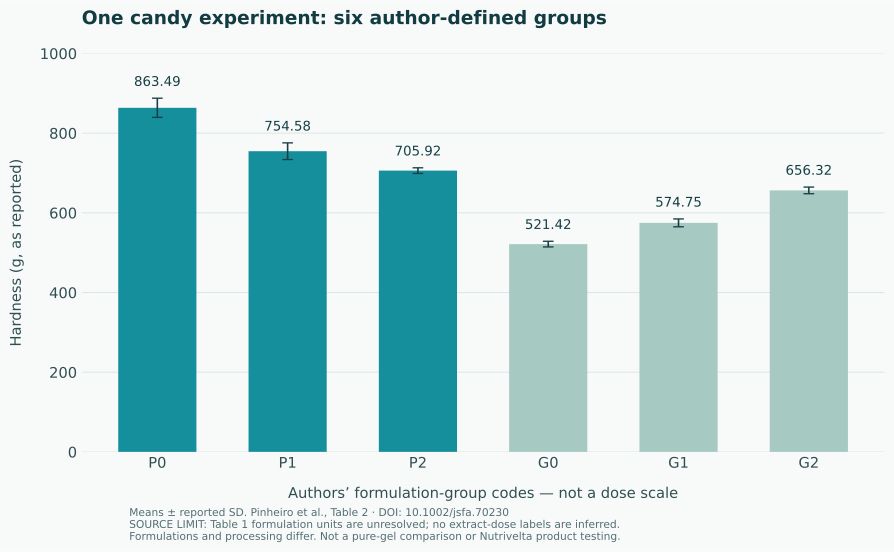
Pinheiro and colleagues studied pectin- and gelatin-based candies containing a peanut-skin phenolic extract. P0 / P1 / P2 and G0 / G1 / G2 are the authors’ formulation-group codes, not a dose scale adopted by this guide. The two gel families used different cooking and drying procedures. These were experimental candies, not a matched test of pure pectin against pure gelatin or of the supplement products in this catalogue.
For texture, the methods describe a TA.XT2i analyser, two compressions with an acrylic disc, a test speed of 1.0 mm/s and a 0.01 N trigger, with ten replicate measurements. The chart reproduces only the six Table 2 hardness means and SDs in the source-reported unit, g. SOURCE LIMIT: Table 1’s formulation heading, entries and footnotes have unresolved unit/amount inconsistencies. No extract-dose labels, percentage interpretation or guessed conversion are assigned to these groups. Treat the plot as a record of what Table 2 reports, not a reproducible formula or universal gel ranking.
P0 / P1 / P2 and G0 / G1 / G2 retain the authors’ group codes for their pectin-candy and gelatin-candy formulations. Formulations and processing differ. Table 1 formulation units remain unresolved; these codes are not extract-dose labels or a pure-gel head-to-head comparison.
| Group | Reported mean (g) | SD (g) |
|---|---|---|
| P0 | 863.49 | 24.09 |
| P1 | 754.58 | 20.89 |
| P2 | 705.92 | 7.09 |
| G0 | 521.42 | 7.13 |
| G1 | 574.75 | 9.89 |
| G2 | 656.32 | 8.35 |
Original redraw of Pinheiro et al., DOI 10.1002/jsfa.70230, Table 2: reported means±SD, with zero baseline. Source-unit warning: Table 1/footnote formulation reporting is inconsistent. No dose conversion or universal gel ranking is inferred; not Nutrivelta product testing.
4. What the example supports—and what it does not
Within the reported P-series, mean hardness decreased from P0 to P2; within the reported G-series, it increased from G0 to G2. That illustrates a formulation-dependent response. It does not show that softer is better, harder is more stable, or one gel should be selected for every supplement. The study used a particular extract and different processing for the two gel families.
For a procurement decision, send the intended active ingredients, serving basis, texture target and pack to the supplier. Ask how the proposed system will be evaluated and which attributes will become part of the specification. A result for a peanut-skin-extract candy cannot be borrowed as a matched test of a creatine or shilajit gummy.
5. Resolve a source conflict before using its formula
The retrieved XML’s Table 1 has an ingredient-percentage heading, while its entries and footnotes use formulation amounts and units that do not line up. The displayed gel-ingredient entry also warrants verification. The source therefore cannot supply a clear extract-dose interpretation for this guide. We do not silently change its numbers or relabel its groups with inferred percentages.
The original group codes and Table 2 cells remain traceable in the retained source notes. A normal request for the publisher page did not obtain a readable typeset clarification, and no correction or author clarification was obtained in this check. Before using the paper to reproduce a formula or make a quantitative product-selection claim, resolve that specific issue. The purchasing discussion can still proceed using the actual proposed formula and its own records.
6. Separate texture, digestion and shelf life
The study’s static digestion work evaluated phenolic compounds and antioxidant measurements in a model system. Those endpoints are not a human trial, a clinical outcome or a shelf-life test of a Nutrivelta product. Even a measured change in one laboratory endpoint would need its own context before supporting a market-facing claim.
For procurement, request the records that answer your question: a texture method for texture, the relevant active assay for declared content, and a defined stability programme for storage claims. Confirm the formulation, lot, conditions and packaging associated with each result. Avoid combining unrelated reports into an overall “quality” conclusion that none of them individually establishes.
7. Turn the comparison into an actionable brief
Send the same requirements to the suppliers being considered: product identity, formula constraints, dietary goals, texture target, serving basis, sample scope, packaging and the documents needed to evaluate the proposal. Ask them to identify what is supported, what needs testing and what is outside their proposed scope. Keep the proposed method and acceptance criteria beside each requested measurement.
Use the responses to agree the next development step: which formula to sample, how the target texture will be evaluated, and which documents will support the specification. Record open questions beside the proposal instead of hiding them in a general quality score. This creates a practical comparison of the supplier options without treating the gel name as the answer to every requirement.
Sources & limitations
- The figure redraws one paper’s reported group means and SDs; it is not a new experiment, a matched pure-gel comparison or a Nutrivelta product test.
- Table 1 formulation/footnote units remain inconsistent.No dose or percentage interpretation is assigned to the author-defined group codes.
- The Table 2 numerical transcription is verified; that does not independently validate the experiment or resolve its formulation reporting.
- Different processes and starting texture prevent a universal gel-superiority conclusion.
- The paper’s in-vitro endpoints do not establish human effects or shelf life.
- Peanut skin bioactive extract on pectin and gelatin candies: is it a potential dietary antioxidant delivery system for health improvement?
Pinheiro LGSD, de Matos AC, Chiocchetti GME, Efraim P, Macedo GA, Macedo JA. 2026
Relevant full-text XML sections and cited tables reviewed through the public Europe PMC API.
- 21 CFR Part 111 — Current Good Manufacturing Practice in Manufacturing, Packaging, Labeling, or Holding Operations for Dietary Supplements
Official rule text retrieved; sections on specifications, verification and quality-control responsibilities identified